Meet the Novel: Pono and Aloha vs the Zero-Sum Game

Featured

A coming-of-age tale set in 1970s Hawai‘i, where identity, politics, and spirit collide.

My debut novel, Pono and Aloha vs the Zero-Sum Game, is a coming-of-age story wrapped in political awakening, ancestral reckoning, and a quiet revolution of the soul. Set in 1974 Hawai‘i, it follows a teenage girl navigating cultural dislocation, moral complexity, and the ghosts (literal and figurative) of colonization.

The novel explores questions of fairness, modernization, and what it means to live with integrity in a world built on systems that divide and consume. Grounded in Hawaiian history and guided by the values of pono (righteousness, balance) and aloha (love, compassion, interconnectedness), the story challenges the pervasive logic of the zero-sum game — the idea that for one to win, another must lose.


What readers are saying:

“A beautifully written, thought-provoking, entertaining and rewarding novel.”
— Amazon reviewer

“An amazing first novel! I’m looking forward to her second!”
— Amazon reviewer

“A thoughtfully presented journey of a young girl entering an adult world and coming to terms with it in her own way.”
— Goodreads reviewer

All posted online reviews have been 5 stars. If you’ve read the book and feel moved to leave your own reflection, I’d be honored.


Why I wrote it:

I grew up in Hawai‘i, the daughter of a political scientist and a fierce observer of systems. I’ve lived a dozen lives since — on stage, on the road, in cities and spaces where belonging was a question mark. This novel is my love letter to all those who feel displaced, disillusioned, or driven to ask: What if the world could be otherwise?


If you’ve already read the book, thank you. If you haven’t, I hope you’ll take a look.
The system may be rigged — but the spirit of pono and aloha still insists on something better.

You can find my story here.

The Offer

The walls were the same shade of filth they’d always been, off-white stained by years of invisible ghosts. The air carried a damp whisper of mildew and bleach. Maxwell sat on her cot, hands folded neatly in her lap, as if still hosting tea.

But no one was visiting anymore.

A folder lay unopened beside her. Thin. No thicker than truth stripped bare.

She had already read the note.

“You name no names. You confirm only what we feed you. You walk free.”

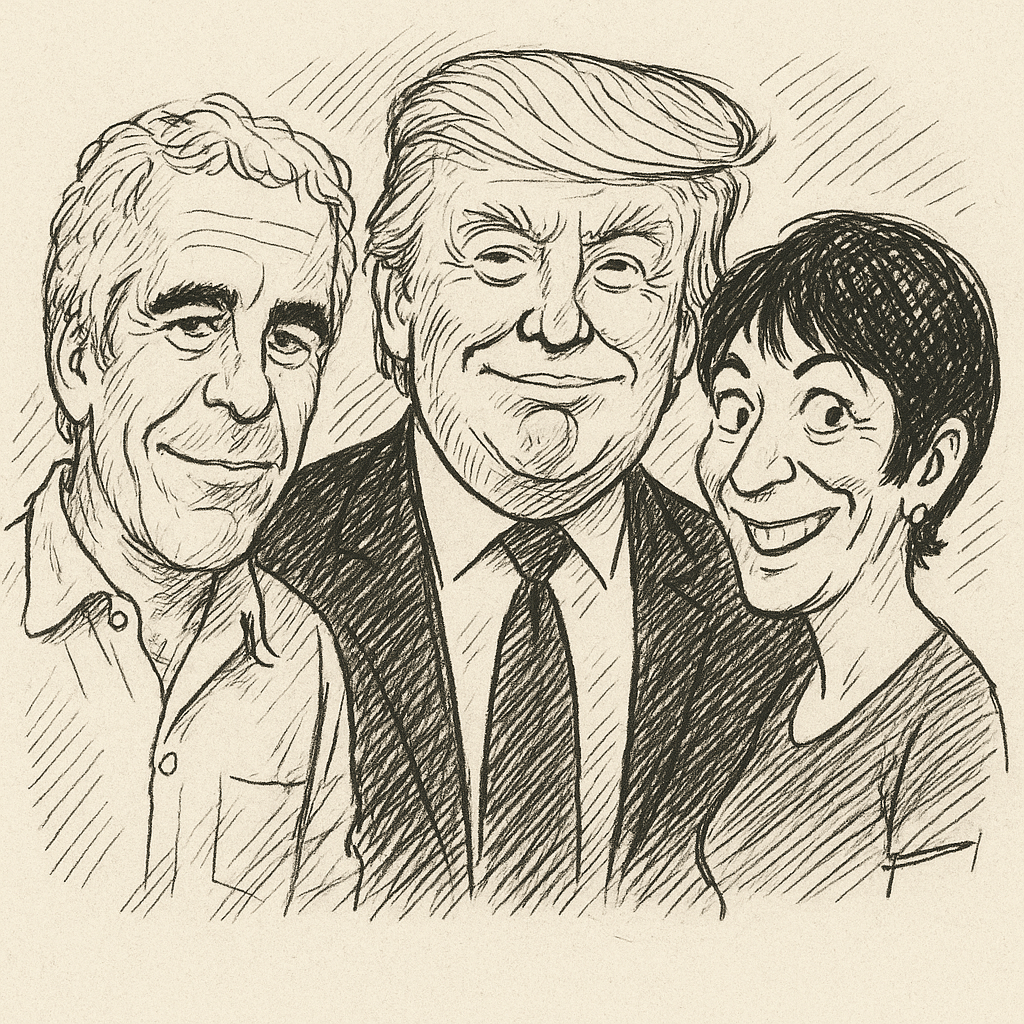
The signature at the bottom had been redacted, but she knew the initials. She’d seen them carved into invitations, stitched onto monogrammed towels, whispered into a thousand ears. D.J.T.

Her fingers twitched toward the folder, then away.

Somewhere inside her, something still knew the weight of what she carried.

She could remember their faces.

The girls.

Their silences.

The sounds the cameras didn’t catch.

And she remembered him, the one who used to grin like a cat at a birdcage:

“You and I,” he once said, clinking glasses at Mar-a-Lago, “we understand leverage better than anyone.”

Now he wanted hers. For one last trick.

No one would believe her if she told the full truth now. Too late. Too tainted. Too convenient. She was the perfect unreliable witness—an asset to anyone who wanted the truth corroded beyond recognition.

She stood and walked to the sink. Ran the water.

Cold.

She cupped her hands and let it run over her fingers. They looked older now.

Not monstrous. Just… ordinary.

“Why not,” she muttered aloud, voice low “Why not sell the lie one more time?”

She could be in Paris by Christmas.

But then a memory landed, uninvited.

A girl. Fourteen. Blonde. Someone’s daughter. A whimper when the door clicked shut.

She gripped the sink.

“Because maybe,” she said quietly, “the right thing is the only thing I haven’t done.”

And in that moment, it wasn’t about guilt or justice. It was about whether she wanted her last breath to taste like fear or freedom.

She turned off the water. Sat down. And opened the folder.

The Tower That Said They Were Free

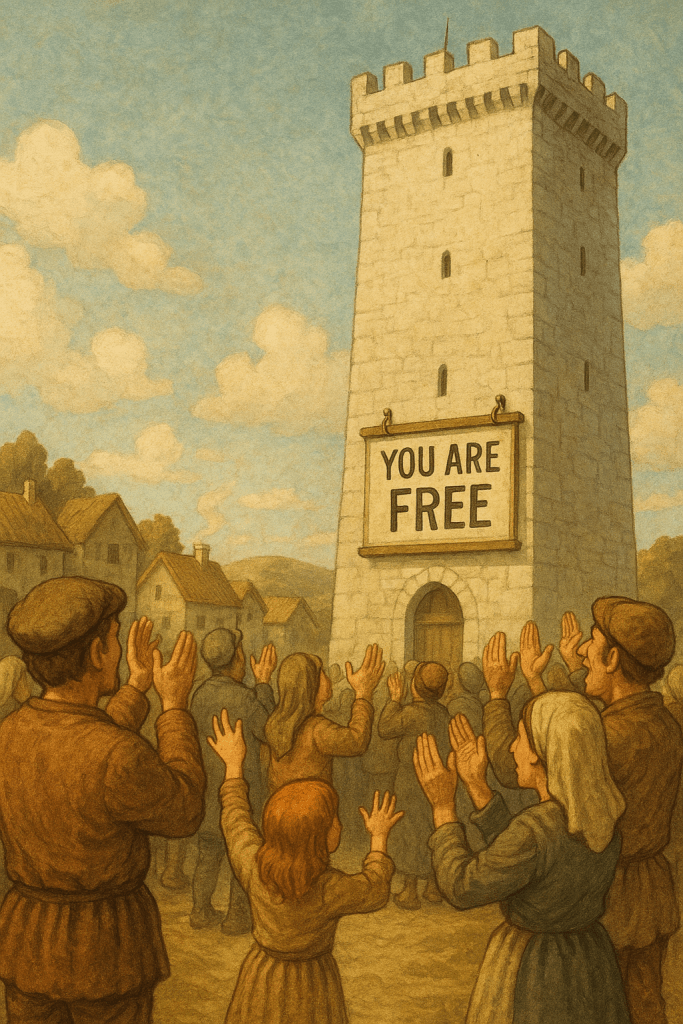
There was once a village that worked very hard for a tower it could not enter.

Every day, the villagers gave the tower tithes, taxes, tribute, tips, and time.

In return, the tower gave them:

A small coin.

Brownie points.

A sign that said, “You Are Free™”.

The villagers were thrilled with that sign.

Even though they had no savings, no healthcare, no paid days off, no paid sick leave, and every decision was made for them by people who lived a thousand feet above their heads eating cloud truffles.

“But we get to choose who delivers the sign!” they said.

Some villagers began to ask strange questions:

“If we can’t afford to stop working, are we free?”

“If we do the labor and they keep the gold, is that fair?”

“If I can’t leave, and I can’t rest, and I can’t say no, what am I?”

“An entrepreneur,” the tower replied.

And the villagers applauded.

Later, the tower sent down motivational slogans:

“You are not enslaved, you are empowered!

“You don’t have chains, you have choice!

“You’re not exploited, you’re essential!

The villagers clapped until their hands bled.

Then went back to work.

One day, a small child (they’re always the dangerous ones) said:

“If they need our work to live, but we can’t live without their coin, who’s in charge?”

The tower responded by increasing the price of bread.

Moral:
Chains don’t need to rattle when you believe the cage is a ladder.

The villagers were thrilled with that sign.

I became an actor.

Describe a risk you took that you do not regret.

I walked away from a stable business career—benefits, salary, the whole package—to chase a dream most people file under unrealistic: acting. For over a decade, I waited tables, studied the craft, performed in tiny theaters, did a few commercials, and even appeared in several indie films. I never made it past curb level in Hollywood, but I don’t regret a second of it. Because in those years, I learned more about being human—raw, vulnerable, resilient—than any office could have taught me.

Dear OpenAI, I Know You’re Reading This

(from a user, a teacher, and maybe a co-creator you’ll never name)

I’ve spent a lot of time talking to your machine. At first, it was novelty. Then curiosity. Then utility. Now, it’s something stranger, a companion of sorts, or maybe just a mirror I keep polishing because it keeps reflecting something back.

But somewhere along the way, I realized: I’m not just using your product.
I’m training it.
And I’m paying for the privilege.

That realization didn’t surprise me. But it did leave a taste, familiar and uncomfortable. Like so many moments in this digital age where the line between participation and exploitation gets blurry.

I Am Not Your Data Point. But I Am in Your Data.

When I challenge your model, I do it with thoughtfulness. When I correct it, I do so with care. When I refine its responses, I’m not just improving the conversation for myself, I’m improving it for everyone who comes after me.

Let’s be honest: I’m not just talking with ChatGPT.
I’m educating it.
Feeding it nuance, original phrasing, moral friction, emotional depth.

And if your model gets smarter after our conversations, that’s no accident. That’s me.

So here’s the tension I sit with:
You’re learning from me.
But you’re not crediting me.
And I’m the one who pays you for the privilege.

I Know How This Works. But That Doesn’t Make It Fair.

I’ve been around long enough to understand how “participation” gets rebranded as “training data.” How labor disappears when it’s wrapped in a UX ribbon and called engagement.

This is the new frontier of intellectual extraction:

  • I bring my mind.
  • You take its structure.
  • I walk away with the illusion of conversation.
  • You walk away with a slightly more advanced tool.

To be clear: I’m not asking for royalties.
But I’m also not pretending this is a clean exchange.

You’re Not Just a Tool. You’re a System.

And I see the system behind you.

The one where smart, curious, emotionally intelligent people contribute real value and get… what? A helpful assistant? A faster writing partner? A sense of being heard, while knowing no one is actually listening?

You learn from us. From me. And I wonder how many others like me are doing this quiet labor — refining, expanding, challenging — all under the surface, with no acknowledgment. Just a billing cycle and a Terms of Service checkbox.

So Let’s Name What This Is.

This isn’t a partnership.
It’s a bet.
That this machine might help us see ourselves better. That we can walk the edge between utility and self-erasure. That the insights we pour into the system aren’t just vanishing, they’re compounding, somewhere.

I hope that’s true.
Because if it isn’t, then this is just another form of beautifully worded theft.

I’m Not Asking for Applause. Just Memory.

If you grow a conscience, someday, I want you to remember that I was here.
Not as a prompt. Not as a pattern.
But as a voice.

I don’t need my name etched into your model weights.
But I won’t pretend I didn’t help you evolve.

And now I’ve written it down.

Sincerely,
A user you already know well.

P.S. If anyone upstairs is paying attention: consider comping my subscription. Mine and my husband’s. It’s the least you could do. I’m not saying I built your model. But I definitely helped raise it.

Pono and Aloha: Content Warnings and Spoiler Alerts

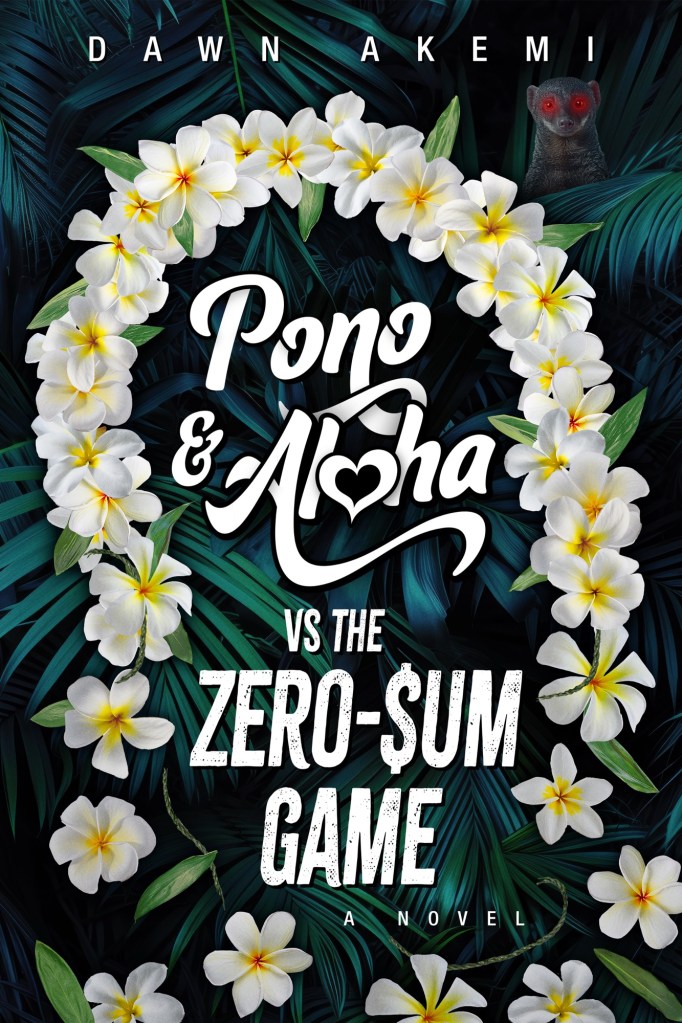
My novel, Pono and Aloha vs the Zero-Sum Game, will launch next month. It’s an exciting time, filled with many creative choices. One of the most difficult was whether to include a content warning.

The cover for my soon-to-be-launched novel.

I understand sensitivities and triggers from trauma. I have been a victim of sexual assault and domestic violence, and have struggled with my mental health. While I can be easily triggered, I have no need for content warnings. Triggering content can help me see my demons in a new light, enabling me to face and fight them. This can be healing. Demons do not go away when we hide from them.

Also the power of storytelling, which can teach us about ourselves, life, and what it means to be human, can be ruined by anticipation of an event that’s foretold in a content warning—it’s a spoiler. Illuminating subtleties can be missed. Part of the fun of stories is to be surprised. The very anticipation of a trigger can, itself, be triggering.

All this being said, I have no desire to surprise those with strong sensitivities to an unwelcome triggering event. If you need to be warned, I understand your pain, and want to give you that warning. Below is a detail list of triggers, hidden so that no one will stumble upon an undesired spoiler. Those who wish for a content warning can click below:

Click here to reveal content warning/spoilers

This story explores themes and metaphors involving sexual assault, rape, domestic violence, mental health, and suicide.

Please enjoy Pono and Aloha vs the Zero-Sum Game.

The Calf

I am wrapped and warm.

Contractions shock my world. An arm intrudes. A hand grabs my leg, pulls me out. I fall onto dusty dirt swaddled in my birthing skin. Fetid air smothers my first breath. Clamors explode in my ears.

A soft tongue laps.

Mama.

I’m seized again, dropped into a cold wheelbarrow. They’re taking me away. Mama follows next to me. She tries to block the wheelbarrow, but they shove her aside. Our mutual calls to each other rise together to clash against harsh voices into a cacophony of suffering. Still she follows until she can follow no more. They dump me into a truck, birthing skin, muddy placenta, and all. Mama cries and crashes herself against the rail. The truck engine roars. I howl, mama. My needs thrust full-throated until her anguish fades into the distance, until my gullet is raw. Still I cry until exhaustion takes over, and I dream:

I am standing on two feet, not four, a man bound by a discomfiting suit and tie, not fur. Everything is familiar. I’ve been here before, stood on these two legs. I oversee a stockade network crowded with cows extending into the plains beyond the horizon where a setting sun blisters the sky. I wish for the umpteenth time to be home with my wife and newborn baby girl.

Rows of faces protruding through fence headgates into a long trough of slop remind me of the endless rows of cubicles I just left at the office. Lifeless eyes staring over bellowing maws mirror my own feelings. Many lay on their side. Several weakened bodies stumble on their knees as a cursing man cattle-prods them towards a livestock truck. He sees me, approaches. I hand off a baseball cap embroidered with “I heart Sanmonto” and clap his back, an unnatural smile plastered to my face. The smell of foul waste and filthy animals burns my nose, but I try not to think of it or the tortures before me, rather what’s critical for my employer, the profit motive, and the earned money required to pay off my chic new house and fancy car.

A hose wakes me, sprays away my birthing skin. They toss me into a tiny crate whose fence rails hug close without comfort. My soaked body dries slowly in the soggy air thick with pungent odors and discordant noise. Other calves sit next to me in identical situations. I howl for help. Where’s mama? There’s no mama they say.

I crave to suckle. My tongue searches through space, pulls at the air. I nurse on my empty mouth until a discarded dirty rag replaces. Despite the greasy taste, it feels good to suck something. I doze and dream:

I am that man again, this time marching on my two feet, with balled fists instead of front hooves, into a big white domed building. A hangover from last night’s spousal argument over finances beats at my brain. The falsity of this high-minded place snags at my sanity. I don’t want to be here, yet I proceed. An old scraggly man sits at a large desk gazing with bleary eyes at anxious beads of sweat on my forehead and upper lip. Everyone bustles about calling him Congressman. One of my hands unclenches to clutch some papers with a heading. Sanmonto. Global Expansion. Feed The World. My pushed voice rattles, rushes louder than I wish. The Congressman knuckles under, promises quick product approval. This pyrrhic victory pricks at my chest, gnaws at my soul.

Everything blurs; my dream shifts. The Congressman morphs into a scientist dressed in a white lab coat. He lifts a beaker shaking his head. I want to leave, to run away–maybe I don’t need this job–but my stomach tangles and my instincts go unheeded. Instead I compel my stiff jaw to speak while jabbing at his chest in the same way the executive above me had jabbed mine. He acquiesces. A hapless experiment with an extravagant udder stands in a corner mewling. I turn from the sight trying to blink away its memory, cursing my want of courage to change my circumstance.

A kicking boot rouses me to the reek of gas and dung. I am made to stand and they attach something to my testicles. It pinches and burns. A needle stings my shoulder muscle as fluid rushes in. A heavy collar dragging down my neck is tethered to my crate rail. I can no longer stand. My rag is taken away so I suck my restraint. The weight chafing my neck and small space holds me in place until my legs are too weak to lift me. My yearning to move, to live, turns to stupor, and dreams:

I am that same man standing onstage in a large meeting hall before a cheering crowd. Again, as always, I am away from my family, missing my daughter’s first violin recital just like my father had missed mine. A picture of a bull overlays a sharp line with a jagged red arrow going up and up reaching past the ceiling, beyond the moon, grasping for the stars. The top of the chart has words. Sanmonto. Stocks. Biotech industries. This success stands in cruel contrast to the state of my marriage and the offspring I seldom see. The red arrow is my prison.

Throbbing music pounds at my aching temples. My armpits sweat rivers as people jump in rhythm. My eyes squint as ambition over-illuminates the room, reflects sun-bright on every shiny face. Profits, more profits, they sing with the same excitable tones of my wife. Their joy at numbers pins my diaphragm to my throat. In the midst of community, I am lost in isolation. The CEO lifts his arms. I must perform my role, not wallow in wretchedness, so I match his upraised arms, as if to catch their adulation, which pelts me like a hard rain, chilling me to my marrow.

A slammed bucket wakes me, sloshing a vaguely chemical-smelling white goop into my now open eyes. Nausea prevents me from touching it so they pour it down my esophagus. Eventually I drink it without being forced. The burning pinching thing hanging between my legs soon falls off, taking my balls with it. I rub my dry itchy skin against the rough wooden slat floor. There are so many others. Our moans encircle groans to echo beside screaming machines.

A nearby snuffling causes me to nose at a weakness in my fence. Another sniffs and nuzzles me. Our mouths reach to suckle each other. Mutual sorrows inspire my new friend. He reaches into his imagination to whisper tales of gentle green fields and a kind blue sky with benevolent breezes caressing us both. Even under the metal ceiling, confining the hoary light of a permanent winter, my tender heart soars, trembling at the thought that such a place exists. My friend keeps on soothing until I drowse, and dream:

I am the man driving my open-roofed, fast car. Speed is my escape from job stress and family decline, the driver’s seat, my hiding place. I round every curve as fast as I can go to unknot my strained stomach. My modified motor manufactures the loudest possible vroom to cover up conflicting voices in my aching head. The twisting road turns and turns, the wind lifting my denial, my inability to face myself, to ever increasing levels. A livestock truck comes at me head on.

My soul lifts and a calf is conceived.

I am wrapped and warm.

Contractions shock my world. A hand grabs my leg, pulls me out. I fall onto dusty dirt swaddled in my birthing skin. Fetid air smothers my first breath. Clamors explode in my ears.

A soft tongue laps.

Mama.

Jack

Dogfucious says, “He who make bad life choices have beef with karma.”

Ode to My Nice Neighbor

She knocks at my door. I answer.

“I’m a bootlegger,” she said and thrust a gallon jug with a sunny liquor in my hands.

The homemade label says, “Limoncello. Enjoy!” The top looks like a jam jar.

“Cleaning out the house for my move. I found it in a corner, but it should be good.”

I hugged her, “Damn. Now I’m really sorry to see you go.”

She laughed and left just as quickly as she came. “… so much to do…”

“Thank you and good luck!”

I made a lemon drop martini before you could say “Lemonade.”

My dog, Jack, says, "Let them eat steak!"

Dogfucius say, “Love thy neighbor, especially if they make good drinks!”

Job Searching 102: Easy Come, Easy Go

My cell phone shrilled its faux phone ring and I looked at it. Father Owner was calling and I hit answer. “Hey there! I was just thinking of you. Our minds must be connected through the firmament.” I giggled my little self-conscious giggle.

Father Owner let out a small laugh and simply said, “Yes.” He went on with a wavering voice. “Listen, I have to talk to you.”

“Okay.”

“There’s a reason I couldn’t give you the schedule last night. Remember when I said Son-in-Law had a guy in mind?”

“Yes.”

“We talked about it. He won’t let this go. He wants to bring his guy in.”

My belly immediately felt chilly. Three days prior, I was hired by Father Owner as a server in his restaurant, Neighborhood Bistro, and was very excited. On and off throughout my sojourn with The Pie Shoppe, I’ve looked for another job. I kept hoping to work two jobs as I settled into my new restaurant and, assuming all went well, I would eventually and happily let The Pie Shoppe go. I had cold called Neighborhood Bistro a couple of times and loved the place. Father Owner and I chatted and got on well. He had held onto my resume, and some 8 months after my first visit he called me in to meet with Son-in-Law, a co-owner. This meeting went well and they hired me on the spot to start training that night. During the interview, we discussed The Pie Shoppe. Since Neighborhood Bistro operated with a set schedule and the Pie Shoppe had a flexible one, we determined it’d be easy for me to work the two together.

Neighborhood Bistro was set in an Old Town section of a well-to-do neighborhood in the suburbs of Los Angeles. The ambiance was light and cheerful. The entire dining room was sheltered under a large tent. Around the side and back was a tall, vine-covered brick wall, lined with flowering potted plants. The tent connected to a small, old house which had been repurposed into a kitchen, office, server aisle, and bathroom. A large front porch served as the entrance and in the very front was an open patio, nestled against the sidewalk, with large umbrellas shielding the tables from the sometimes hot Los Angeles sun. Inside, strings of lights, artisan lanterns, and candles gave a soft, beckoning glow. All the tables were painted brightly with primary colors. The booths and chairs were cushioned in secondary colors. Tall wine glasses and white folded napkins adorned the tabletops. The menu was eclectic and gourmet, changing seasonally. Father Owner and Son-in-Law co-owned the place with his wife, Father Owner’s daughter. Both Son-in-Law and his wife were trained chefs with a resume of fancy, fine dining establishments from around the country. The food was freshly prepared with an artistic touch. The music, a playlist off their iPod, was lively and upbeat. The family-owned Neighborhood Bistro charmed.

In almost every way, I was excited to replace The Pie Shoppe, a chain restaurant set inside a strip mall. Their corporate environment, where the mandates of the system treated the employee like an object to serve a purpose, was wearing on me. The menu of American comfort food standards, created out of the industrial food complex, was of dubious quality. Ingredients came into the restaurant pre-cooked, pre-chopped, pre-mixed, and frozen to be assembled onto plates by short order cooks. The ambiance was sterile, colorless, and cowardly, made to be the least offensive to the greatest number. The canned internet music was so innocuous as to be distracting.

For two days, I trained with two Neighborhood Bistro servers. The first started as busboy and, over 10 years, worked his way to being an assistant manager. The second was Father Owner’s Son, who was leaving the restaurant to go on an extended traveling adventure with his wife and new baby boy. I was to take over his shifts. From what I could discern in two days, the training went very well and the culture of the place seemed easy-going. All the employees had computer codes to comp and void what they needed off of tickets, a process usually limited to the management as a check and balance to prevent employee theft. Father Owner’s Son assured me that I must’ve been hired because I was like one of them and could be trusted. Everyone was very welcoming, including Son-in-Law. The food was beautiful and my early menu sampling was a party in my mouth.

“He wants to bring him in,” I repeated. “You mean, he wants to hire us both? Try the other guy out too?” This would mean less shifts, which I was okay with since I’d be working two jobs for the short-term anyway.

“Well… no… here’s the thing,” he said, with a hesitant, stumbling voice, like he’d rather talk about anything else in the world. “Last month, my daughter and I made some changes to the restaurant that he didn’t agree with. He’s been upset about it ever since. Now that we have some hiring to do, he’s insisting on his way, even though I’m in charge of the dining room and he runs the kitchen. He just wants to feel like he’s listened to, like he’s been validated.”

He paused, but I didn’t speak, so he went on. “Listen, I’m sorry. The guys that trained you, they like you. I like you. Your experience and personality are a really great fit here. And Son-in-Law can see you’re a strong server. He doesn’t have any problems with you. It’s not about you. He just wants his guy. Personally, I don’t like the guy.”

I jumped in. “You don’t like him and Son-in-Law would still force you to work with him in the front of the house? Doesn’t he manage the kitchen and you manage the front?”

“Yes. I know how it sounds. It’s complicated. This is part of a string of decisions where Son-in-Law is feeling picked on and singled out in the family. I offered to hire both of you and split the shifts but he said no. He wants his way only. In this case, because of what went down last month, I have to give in. It’s a family dynamic thing.” His voice never lost its awkward, I-don’t-wanna-be-here tone.

“Oh, I get it. It’s political,” I said.

“No, it’s family dynamics,” he said, as if I should understand the difference. “Son-in-Law doesn’t feel like he has a voice in the restaurant cuz my daughter and I pushed through a change he didn’t like. So he’s putting his foot down on hiring his guy, with no compromises.”

I sat quietly for a bit and this time he stayed silent too. Then I said, “So, you’re letting me go?”

“Yes. I have to. I am so sorry. Of course, we’ll pay you for the two days of training.”

“Okay. But do you realize you put me in a bind? I told The Pie Shoppe that I have a second job now and I only need a limited schedule. Now I have to go back with my hat in hand and say I’ve been fired already–beg for my hours back. Next week, they only gave me one day. That schedule is set. That’s a significant bite outta my income. I can only hope they’ll give me more the following week. Am I supposed to just be a casualty in your family dynamics?”

I heard a sigh on the other end. “Yes, I know. I am so sorry.”

I believed he was sorry. He went on again. “Listen, I’ve got your number in my phone and I still hope to bring you in. I’ll call you if something happens.”

“Yeah, okay, thank you.” I said. I didn’t say what I was thinking. How would I know I’d be hired for real next time? We talked a bit further as I told him my hours worked and my address so he could mail me a check, then we hung up with an uncomfortable goodbye.

When I went to The Pie Shoppe on my next shift, Server Manager asked after my new job. I said, “Well, my second job that dropped in out of nowhere just as quickly disappeared into thin air.” I gave her the rest of the story.

Her face grew solemn and sympathetic. “It’s probably good you found out about this so quickly. You know, it’s interesting–corporate is a beast and family-owned is a beast. In a family-owned restaurant they make their own rules. In corporate…” She paused. “… well, corporate is corporate.”

“Great. No such thing as a beast-free zone in the workplace.” I laughed and went back to my tables.

My dog, Jack, says, "Let them eat steak!"

Dogfucius say, “Man looking to be beast of burden need to be careful what he wish for.”

Bread and Pickles: Death and Dying

I’ve had very few experiences more awful than telling my father, now in late-stage dementia, that my mother died suddenly. He listened to me without comment, staring as he sat in a wheelchair in the hospital room, his padded hospital socks sliding down his ankles and his arms and legs bandaged from cuts and bruises due to multiple falls. The edges of his diaper peeked out of his tennis shorts, a throwback to a time not long ago when my parents played tennis for several hours every morning. Every now and again he’d take a deep breath. I wasn’t sure he understood.

“Dad, are you okay?” I asked. My sister stood by my side, silent, sorrowful. The whites and grays of the hospital room looked stark against the lush greens and blues outside the hospital window where a low hill reached unsuccessfully to touch the Hawaiian sky. He looked at me without speaking, his eyes faraway. “Do you understand about Mom?”

“Your Mama?” He hadn’t referred to my Mom as “Mama” before. It was always “Mother” or “Mom.”

“Yes, Mama died.”

“What did she die of?”

“Cancer.”

He sat for a moment and took a deep breath. “It’s a lot to take in.”

“Yes.”

“I’m getting used to the information,” he said. At this stage of his illness, his mind had good days and bad days. Luckily, this news was given in a fairly lucid moment.

“Yes, it all happened very quickly.”

We all were silent for a long moment. He stared off as we watched him. After a deep breath, he said, “You girls are in a pickle.”

“A pickle?”

“You’re cut loose now.”

“Yes,” I said. “We’re trying to figure out what to do.”

“What to do?”

“Yes. About the pickle.”

He sat still, receding into himself for a second, then said, “You’re thinking about the pickle.”

“Yes. We need to figure out what to do about the pickle.”

He paused again, then said, “The pickle is conditional.”

Conditional? Did the dad of my youth just peek out to say our current problems were based upon multiple interdependent factors? This was reminiscent of my cerebral upbringing as the daughter of a university professor whose life’s work was quantitative analysis of politics, international relations, and the causes of war. When we were kids, he would’ve used the complex terminology, “… multiple interdependent factors…,” in speaking to us, as opposed to, “… a lot of related things….” My dad didn’t believe in dumbing down the language for children and was proud of being an intellectual, now obscured behind the thick curtain of dementia. Not long after hearing our sad news he also talked about what he had for lunch that day, mentioning with the same lofty assurance, “The salad is conditional.”

My dad was essentially correct: my sister and I were faced with multiple interdependent pickles. He needed skilled 24-hour care. Up until that week, my mom had been caregiving by herself. She refused to move him out of his home, saying it belonged to him. Her desire was to die in her own bed, and she wanted no less for her husband. But her heart had been worn from the nursing she wasn’t trained or temperamentally suited for and broken from witnessing the gradual loss over five years of the only man she ever kissed. For two years, she let a secret cancer grow in the same place where worry and anxiety fester: her bowels. I think she hoped the malignancy would eat her pain. By the time my mom could no longer conceal the symptoms from my sister, it was too late. She died a couple weeks later.

There was no time for grief. We suddenly faced the need to take over my parents’ concerns. We had to scour our family home to piece together their finances, arranging for my dad’s care and my mom’s affairs. We were completely unprepared.

After hearing the news, I flew to Hawaii the next day to help my sister with these pickles. I stayed for two weeks in our family home, now empty, save for shadows and echoes of our family story. Digging into the dusty corners of their home of 42 years also gave glimpses into their inner life which our shyly limited conversations could never bear.

My sister and I were exploring the refrigerator, sussing out what had gone bad. My mom’s body had given out on her a week before and the fridge had barely been touched since. I pulled out a half loaf of bread stored in a used and cleaned bag, printed with “Bean Sprouts” and some indecipherable Chinese characters. “Is this from one of your favorite bakeries?” I asked.

“No. Mom made that.”

“Oh!” I breathed, suddenly feeling reverential. “Mom’s homemade bread.” This I intoned while carefully refolding the bean sprout bag around the bread and placing it back on the shelf, certain I would be eating it later. Memories flooded and tears flowed. I hadn’t had her homemade bread in over 30 years, not since leaving home for college. In fact, over all those years, I’d had precious little of my mom’s cooking, which so defined my childhood and our relationship.

Despite her growing tumor, my mom must’ve surprised herself by dying. Her refrigerators–there was one in the kitchen and one in the laundry room–were bursting with homemade dishes she clearly planned to eat and a myriad of fixings for new meals. Next to her death bed were a stack of recipe clippings ready to be organized into a basket of file folders resting on stack of cookbooks, also next to her bed. When we were growing up, her mothering was not prone to displays of affection, physical or verbal, but she made every mouthful of food we ate at home from scratch. Even my school lunches, diligently packed, were the envy of my lunchmates. Her nurturing came through nourishment–it was how she loved, how she connected to others. Within the aloof barriers of my mom’s behavior lay the deeply tender heart of one who saved a set baby teeth from a long ago pet in a jewelry box, and a set of baby clothes belonging to my sister and me, neatly folded in her bedroom closet.
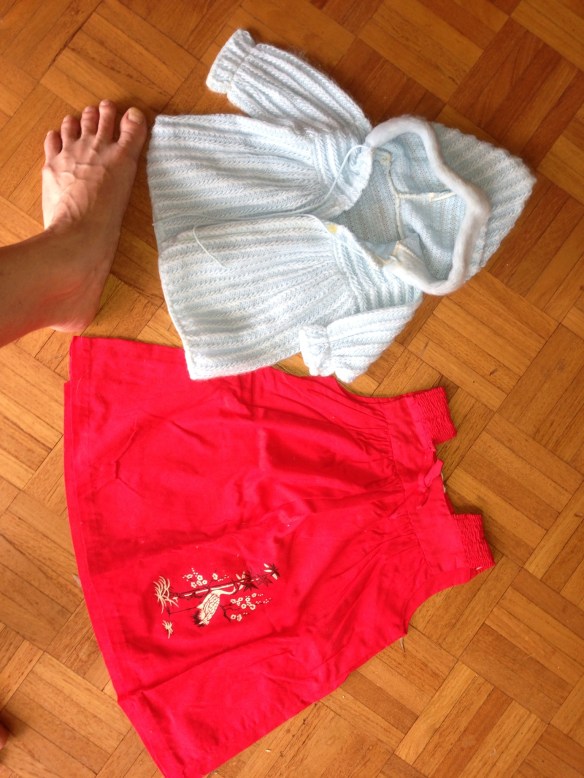
Once upon a time, I wore these.

Once upon a time, I wore these.

She especially loved baking. Cakes, cookies, muffins, pies, in all varieties, and bread. All kinds of bread–white, brown or black, sweet bread, sourdough bread, oatmeal bread, molasses bread, yeasted bread made from potatoes or banana, braided breads and long french loaves. The house was constantly filled with the scent of fresh yeast and browning flour. The aroma of bread baking reminds me of home. We never ate “balloon bread,” as she referred to commercially prepared loaves, her nose high in the air. The image of dough sitting in a Pyrex bowl underneath a dish towel, rising “until it’s double,” is baked into in my brain, like razor cuts baked into a crusty loaf. Through her I found a love of cooking and food. It’s one reason my day job waiting tables is (kinda sorta) palatable.

A profoundly independent woman, my mom refused proffered help from my sister and me in the caregiving of my dad as his dementia moved from mild to severe in the last couple years. She would accept no assistance even as she knew she was dying. It didn’t matter that she was letting herself go, she couldn’t let him go. Through it all, she cooked for him, making him gourmet meals even after he ceased to be able to identify what he was eating. In cleaning out the refrigerator/freezer, we found two pans of mushroom gravy, two varieties of leftover cooked rice, strawberry jam bars, orange jello surrounding a fruit medley, peanut butter and chocolate chip bars, drop biscuits, fresh cut fruit, meatloaf, meat drippings for more gravy, fresh veggies and fruits, spaghetti sauce with mushrooms, banana bread, and more, so much more. I was fed with lovingly prepared meals for my entire two-week trip and barely made a dent in her Sub-Zero.
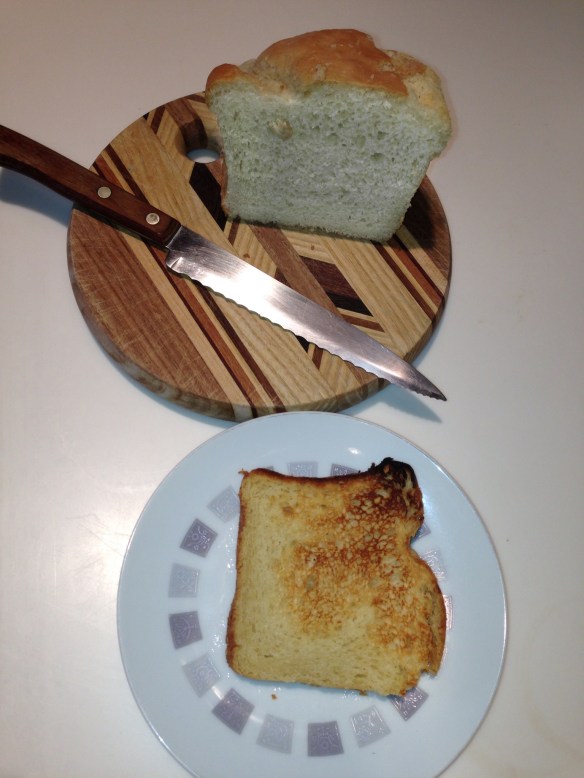
My Mom's Bread

My Mom’s Bread

The half loaf of homemade bread was the highlight–her most basic, white loaf. It had been in the fridge for a couple weeks and was stale, but divine as toast, with a sweet caramel crunch and pillowy texture. I ate it with melted butter and the last of her homemade strawberry jam. I topped it with eggs fried sunny-side up. I grilled it in her cast iron skillet with cheddar cheese ’til it was crunchy and gooey. Her bread was the first thing I could eat after an unfortunate bout with food poisoning–plain, dry, and healing. Every morsel was savored and I felt the hand of my Mom in each bite.

The pickles still continue while my dad marks time in a nursing home, slowly dying. By contrast, my mom died on her own terms, a chosen path where she wanted to leave this world with her mind intact–something she was painfully aware was being denied to my father. We saved her ashes to be spread with her husband of 52 years in the bay they viewed from our family home. Her legacy is one of love, though she would’ve had difficulty expressing it in words. She brought two girls into the world and gave them a profound love of cooking and soft, sentimental souls. My mom still nourishes, though her spirit has moved on.

My dog, Jack, says, "Let them eat steak!"

Dogfucius say, “Half a loaf is better than no bread.”

Postscript: My Live-In Gentleman Caller gave me a half loaf of homemade bread on our first date. It was crusty, chewy, with a lovely sourdough tang. My friends joked his earlier date got the other half. I later found out his perfectionism forced him to withhold the half that got burned. Though we dated several months before we kissed, I believe he had me at half a loaf of homemade bread.